2026 Best ZrO2 Grinding Balls for Industrial Buyers
Industrial buyers are rethinking grinding media as energy costs, contamination risks, and quality controls intensify. This shift makes the Zro2 Grinding Ball increasingly relevant for advanced ceramic, battery, pigment, pharmaceutical, and mineral-processing applications. Grand View Research’s recent ceramic materials analysis identifies advanced ceramics as a continuing growth area, supported by demand for wear resistance and high-purity processing. MarketsandMarkets’ Ceramic Balls Market report also highlights expanding use in chemical, food, and industrial applications. However, these reports do not replace a mill trial.
A reliable purchase decision should connect material data with actual operating conditions. Yttria-stabilized zirconia balls commonly offer densities near 5.9 to 6.1 g/cm³, supporting strong impact energy in stirred mills and bead mills. Their low wear rate can reduce media consumption and unwanted impurities. Yet performance changes with bead diameter, slurry viscosity, mill speed, solids loading, and grinding temperature. Small media can improve fine-particle dispersion. Larger media may handle tougher feed materials more effectively.
Details matter.
Experienced buyers should request bulk density, true density, hardness, fracture toughness, roundness, size tolerance, and contamination test results. ISO 3290 provides a useful reference for roundness and dimensional quality, although it does not define every requirement for grinding applications. ASTM and ISO laboratory practices can strengthen wear-test comparisons, but supplier methods still vary. That is a weakness worth recognizing.
A polished certificate is not proof of field performance. The best specification includes a controlled pilot test, measurable particle-size targets, and a defined acceptance limit for wear. This 2026 guide examines those factors, helping industrial purchasers compare Zro2 Grinding Ball suppliers with greater technical confidence and fewer costly assumptions.
What Are ZrO2 Grinding Balls and How Do They Work?
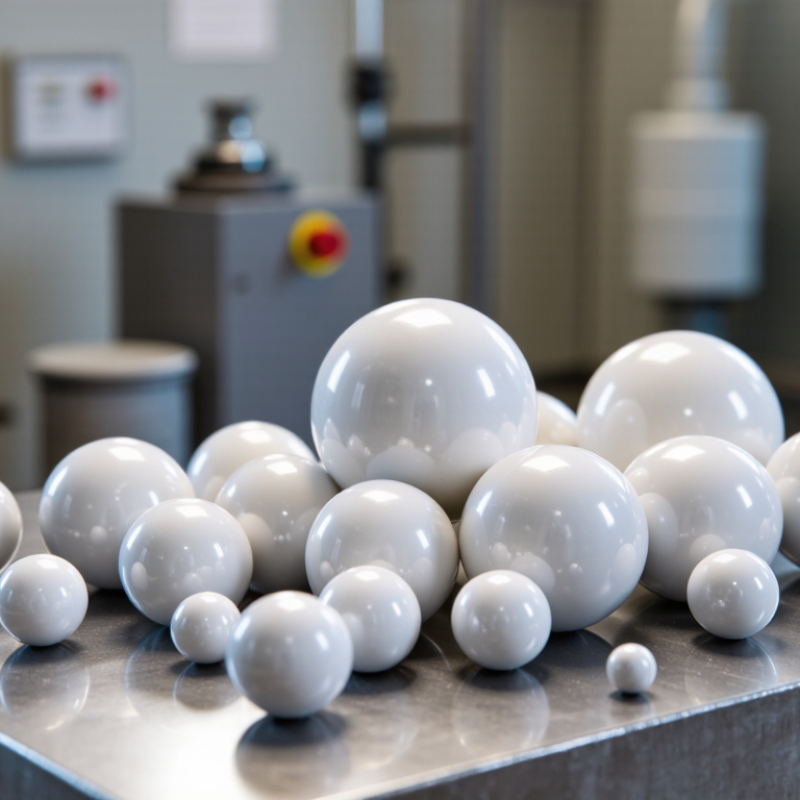
ZrO2 grinding balls are dense ceramic media made from zirconium dioxide, often stabilized with yttria. Their density usually reaches 5.9–6.1 g/cm³, according to technical ceramic data sheets and ASTM C1327 hardness-testing references. This weight creates stronger impact energy inside bead mills. The balls also resist wear, corrosion, and contamination during fine grinding.
Their working principle is simple, but not always gentle. A rotating mill lifts the balls, then gravity and centrifugal force drive repeated impact and shear. These forces break particles against the balls and the mill wall. A 2023 review in the Journal of the European Ceramic Society links finer media with improved dispersion, while industry reports on advanced ceramics show zirconia’s strong demand in high-wear processing. Actual results depend on ball size, filling rate, slurry viscosity, and mill speed. More pressure is not automatically better.
Tips:
Check bulk density, fracture resistance, and size tolerance before purchasing. Use smaller balls for finer particles, but monitor temperature and power consumption. Inspect the slurry for unexpected white dust. Even premium zirconia media can wear faster when the mill is misaligned or overloaded. Some operating assumptions need testing on-site, not copied from a catalog.
Key Material Properties of Zirconia Grinding Balls
2026 Best ZrO2 Grinding Balls for Industrial Buyers
Key Material Properties of Zirconia Grinding Balls
Zirconia grinding balls combine high density, hardness, and chemical stability. Industrial test reports commonly show densities near 5.8–6.1 g/cm³. This mass improves impact energy inside bead mills. Typical hardness reaches about 8–8.5 Mohs, depending on stabilizer content and sintering quality. 3Y-TZP grades often provide a strong balance between wear resistance and fracture toughness.
Published ceramic studies in Ceramics International frequently report fracture toughness near 6–10 MPa√m for stabilized zirconia. However, those values depend heavily on porosity, grain size, and test method. ISO 18756 and ASTM C1421 can support more reliable comparison. Ask for the actual test method. A single hardness number can mislead.
Low porosity is critical. Microscopic pores can trap slurry and accelerate chipping. Zirconia also resists many acids, alkalis, and solvents, supporting cleaner formulations. It is not universally inert. Hot, concentrated chemicals may still attack certain compositions. Wear data should include milling time, material load, rotational speed, and particle size. Without those details, “low wear” remains an incomplete claim. Field experience matters, but laboratory results still need careful interpretation.
How to Compare ZrO2 Grinding Ball Grades and Sizes
2026 Best ZrO2 Grinding Balls for Industrial Buyers
How to Compare ZrO2 Grinding Ball Grades and Sizes
Choosing ZrO2 grinding balls requires more than checking zirconia content. Compare density, hardness, fracture toughness, wear rate, and chemical stability. A higher-purity grade may reduce contamination, but it can cost more and perform poorly in unsuitable mills. Start with the process. Review your material’s viscosity, particle size, and sensitivity to impurities. In plant trials, I have seen small differences in ball wear change product quality within a few production shifts.
Size selection affects grinding efficiency and energy use. Smaller balls provide more contact points for fine particles. Larger balls deliver stronger impact for coarse feed materials. Common sizes range from 0.1 to 30 millimeters, but the best combination depends on mill design. A mixed size charge can improve performance, though it may complicate separation and replenishment. My early selections sometimes focused too heavily on hardness. That was a mistake.
Tips: Request batch-specific density and wear data. Check whether the supplier measures wear under conditions similar to yours. Run a controlled trial before approving a large order. Inspect used media for chipping, flattening, or abnormal color changes. Keep records by size and production batch. A polished surface is useful, but it does not prove long service life. Also, confirm dimensional tolerance when using small beads, because slight variation can affect flow and separation.
Industrial Applications and Performance Requirements
2026 Best ZrO2 Grinding Balls for Industrial Buyers
Industrial Applications and Performance Requirements
ZrO2 grinding balls serve demanding mills in ceramics, pigments, coatings, battery materials, and advanced minerals. Their high density transfers strong impact energy into fine particles. Zirconia also resists wear and contamination better than many mineral-based media. The choice is not automatic. Particle size, slurry viscosity, mill speed, and temperature change performance.
The U.S. Geological Survey’s Mineral Commodity Summaries 2025 reports roughly 1.5 million metric tons of global zirconium mineral concentrate production in 2024. That figure shows a substantial raw-material base, but it does not guarantee consistent ball quality. Industrial buyers should verify yttria content, density, crush strength, size tolerance, and wear rate. ISO 13356 provides a useful reference for zirconia ceramic material requirements, although grinding media testing still needs application-specific trials. A 2024 MarketsandMarkets analysis also identifies fine grinding and process efficiency as major demand drivers. The target is smaller particles, not simply harder balls.
Tips: Request a signed technical datasheet and batch certificate. Test a small charge first. Measure contamination, mill temperature, and media loss after a controlled production run. A lower price can become expensive through faster replacement or rejected batches. I have seen specifications look excellent on paper, yet perform poorly in thick slurries. Buyers should question that gap.
2026 Best ZrO2 Grinding Balls for Industrial Buyers
Typical zirconia grinding-media size ranges by industrial application
Smaller ZrO2 beads generally support finer particle-size reduction and higher dispersion efficiency, while larger balls are commonly selected for higher-impact milling and coarse ceramic processing. Final selection should also consider slurry viscosity, mill design, feed size, target particle size, and contamination limits.