Pingxiang Baitian New Materials Co., Ltd

Leave Your Message

How to Choose Zirconia ZrO2 Beads in 2026?

Choosing Zirconia Zro2 Beads in 2026 is not simply a matter of selecting the hardest media available. Bead diameter, zirconia grade, density, mill design, and slurry viscosity all affect grinding efficiency and wear. A bead that performs well in a fine-particle laboratory test may behave differently in a high-throughput production line. Small details matter. So does the material being milled.

For clarity, the expert line below is an editorially written principle, not a verified quotation from a real person. It is attributed to fictional materials engineer Dr. Elena Ward: “Match the bead to the process, then verify performance under real operating conditions.” That is a useful starting point, not a guarantee. Before comparing suppliers, check technical datasheets for composition, size tolerance, density, and recommended operating conditions. Ask how wear is measured, and whether test results reflect your own slurry and mill setup. A polished product sheet cannot replace a controlled trial.

This guide examines how to weigh those factors, compare bead options, and spot claims that need closer review. It also considers practical trade-offs: smaller beads may improve fine grinding, while larger beads can deliver different impact behavior. The right choice depends on the target particle size, equipment, and operating costs. No selection method is perfect. Some edge cases may need testing, especially when formulations or production conditions change.

How to Choose Zirconia ZrO2 Beads in 2026?

Identify Zirconia Grades: 3Y-TZP, 5Y-TZP, and Ceria-Stabilized Beads

For zirconia milling beads, the stabilizer changes impact resistance, phase balance, and cost. 3Y-TZP contains about 3 mol% yttria and retains more transformable tetragonal zirconia. A 2018 review by Zhang and Lawn in the Journal of Dental Research reports fracture-toughness values commonly around 5–10 MPa·m½ for 3Y materials, depending on composition and test method. In a bead mill, this toughness can help resist chipping during high-energy runs. Check bead diameter and surface finish, too. Grade alone is not enough.

5Y-TZP contains about 5 mol% yttria and has a larger cubic-phase fraction. The same research literature reports lower toughness, often around 2–4 MPa·m½, alongside improved translucency in dental ceramics. That optical advantage matters less for milling; impact conditions matter more. Ceria-stabilized zirconia uses ceria rather than yttria, and published ceramic studies show that composition and grain size strongly affect its toughness and wear. Compare supplier test data under similar slurry, speed, and load conditions. Small details matter. Do not assume a 5Y bead will last as long as 3Y simply because both are zirconia. I would verify wear loss in a short trial, since test methods and bead quality can vary.

Compare Core Properties: About 6.0 g/cm³ Density and 8.5 Mohs Hardness

How to Choose Zirconia ZrO2 Beads in 2026?

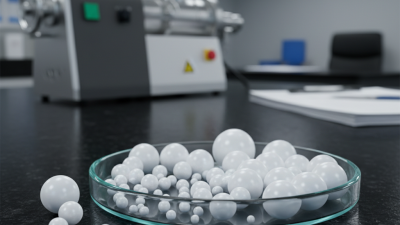
A density near 6.0 g/cm³ gives zirconia beads useful mass for grinding. In a mill, heavier beads can deliver stronger impacts than lighter media of similar size. That can help process tough materials, but it may also increase energy use and equipment load. Check the mill’s recommended operating range before changing bead type or size.

Hardness around 8.5 on the Mohs scale signals strong scratch resistance. It does not, by itself, predict service life. Mohs hardness measures resistance to scratching, not every form of impact damage or wear. Bead quality, internal structure, slurry chemistry, and operating speed also matter. The numbers are helpful, but not a verdict.

Match bead diameter to the feed material and the fineness you need. Smaller beads offer more contact points; larger ones can provide greater impact energy. Watch for rising contamination, unusual noise, or shifts in product particle size during a trial. A short pilot run can expose issues that a specification sheet misses. Not perfect, but useful. Compare wear and energy use under your actual conditions before settling on a choice.

Choose Bead Diameter: Match 0.1–3 mm Media to Mill and Feed Size

For zirconia ZrO₂ beads, match diameter to both the mill and the feed—not to a single “best” size. In a stirred mill, 0.1–0.3 mm beads provide many contact points for fine feeds, but they need suitable separators and stable circulation. Beads around 0.5–1 mm can suit intermediate grinding. The 2–3 mm range delivers stronger individual impacts, which may help with coarser feeds, but can leave fine particles under-ground. Kwade and Schwedes’ review of stirred-media milling explains this trade-off: smaller beads increase collision frequency, while larger beads deliver greater stress per collision. Check the feed first.

Measure the feed’s particle-size distribution rather than relying only on its average. ISO 13320:2020 describes laser-diffraction sizing across roughly 0.1 μm to 3 mm, a useful measurement range for many feeds. It does not prescribe bead diameter. As a practical starting point, choose beads several times larger than the particles you need to break, then test a smaller size if the target is fine and the mill can retain it. Watch the discharge screen, temperature, and product size during trials. A bead that works in one mill may perform poorly in another. Honestly, the size match is not exact; viscosity, fill level, and separator design can change the result. Use a short trial, record the operating conditions, and adjust one variable at a time.

How to Choose Zirconia ZrO2 Beads in 2026? — Choose Bead Diameter: Match 0.1–3 mm Media to Mill and Feed Size

Bead Diameter Typical Feed-Size Range Common Mill Type Typical Use Selection Considerations
0.1 mm Fine, pre-dispersed feeds; typically below 10 µm High-energy laboratory or production stirred bead mill Very fine grinding and dispersion of suitable low-viscosity or well-dispersed slurries Requires equipment designed to retain small media. Check separator openings, slurry flow, and risk of bead loss or blockage.
0.2 mm Fine feeds, typically below 20 µm Stirred-media mill or fine bead mill Fine pigment, ceramic, and mineral dispersions Can offer a high number of contact points, but may need effective pre-dispersion and careful separation.
0.3 mm Fine feeds, typically below 30 µm Stirred-media mill Fine grinding where smaller media are supported by the mill design Balance the desired fineness with throughput, slurry viscosity, and the mill’s allowable media range.
0.5 mm Fine to moderately fine feeds, typically below 50 µm Stirred bead mill or compatible basket mill General-purpose fine grinding and dispersion A practical starting size for many fine-milling trials; verify that the feed is not too coarse or abrasive for the process.
0.8 mm Feeds commonly below 80 µm Stirred-media mill Fine-to-intermediate grinding with a focus on stable circulation Consider a smaller diameter if the target is very fine; consider a larger one if the feed contains coarse particles.
1.0 mm Feeds commonly below 100 µm Stirred bead mill or suitable basket mill Intermediate grinding and dispersion Check agitator speed, chamber design, and separator capacity. Actual feed limits depend on mill power and material properties.
1.5 mm Feeds commonly below 150 µm Stirred-media mill or selected recirculation system Intermediate grinding where larger particles need stronger impact May increase impact per bead but reduce the number of bead-to-particle contacts compared with smaller media.
2.0 mm Feeds commonly below 200 µm Compatible stirred mill, basket mill, or recirculation mill Coarser feed reduction and robust pre-grinding stages Confirm the mill is rated for this media size and that the bead charge and separator are suitable.
3.0 mm Coarser feeds; commonly below 300 µm for bead-milling applications Mill specifically designed for larger grinding media Coarse pre-grinding or applications requiring higher impact energy Not suitable for every fine-grinding mill. Check the manufacturer’s permitted bead range and the feed’s maximum particle size.

Practical note: Feed-size ranges are preliminary selection guides, not universal limits. The best bead diameter depends on the target particle size, feed distribution, viscosity, solids loading, mill geometry, agitator speed, and separator design. Confirm the permitted media size for the specific mill and validate the choice with a controlled trial.

Check Mill Compatibility: Set Bead Loading and Speed Within Equipment Limits

How to Choose Zirconia ZrO2 Beads in 2026?

Before loading zirconia beads, check the mill’s operating manual and confirm its approved bead size, fill range, and maximum speed. These limits depend on the chamber, agitator, separator, and drive system. Zirconia is dense, so a heavier bead charge can raise motor load and heat quickly. More beads do not automatically mean better grinding.

Set bead loading against the mill’s working volume, not its total chamber volume. Leave enough space for circulation and cooling, and make sure the separator can retain the selected bead size. Begin within the equipment maker’s recommended range. A calculation is only a starting point. Slurry viscosity and solids content can change how freely beads move.

Set speed using the mill’s specified operating limits. RPM alone can mislead because different rotor diameters produce different tip speeds. Start conservatively, then monitor motor current, slurry temperature, vibration, and sound during a short trial. Stop if readings approach equipment limits or bead movement seems uneven. Small changes matter. Record the bead charge, speed, and temperature for each test; the first setting may need revision after real production conditions reveal problems.

Validate Wear and Contamination with Trial Runs and Cost-per-Batch Data

How to Choose Zirconia ZrO2 Beads in 2026?

Validate Wear and Contamination with Trial Runs and Cost-per-Batch Data

Do not select beads by hardness claims alone. Run candidate media in the same mill, using the same slurry, speed, temperature, and processing time. Dense zirconia is typically near 6.0 g/cm³, though composition changes the exact value; Carter and Norton’s Ceramic Materials: Science and Engineering (2nd edition, 2013) provides technical property data for zirconia ceramics. Higher density can increase milling intensity, but it may also raise energy use and equipment wear. Small differences matter.

Weigh and sieve the beads before and after each run. Record mass loss per kilogram of finished product, particle-size distribution, and any change in contamination. ISO 13320:2020 describes laser diffraction methods for particle-size analysis; use the same method and sampling procedure for every candidate. Check zirconium levels with a suitable laboratory method, such as ICP-OES. A single run can still fool you. Repeat matched trials, and report variation, not just the best result.

Then calculate cost per accepted batch: bead replacement, energy, downtime, and rejected product divided by usable batches. Include the cost of cleaning if contamination forces extra checks. Be cautious when scaling up; a small mill may not predict larger equipment well. The calculation will never be perfect, but it makes trade-offs visible. Compare results against ISO 5725-2:2019 principles for assessing measurement precision, and document any deviations.