Pingxiang Baitian New Materials Co., Ltd

Leave Your Message

7 Tips for Buying Zirconium Ceramic Balls

Choosing the right Zirconium Ceramic Ball can influence wear life, product purity, and equipment stability. These small spheres may look identical in a sample tray, yet their performance can differ significantly. Density, zirconia content, bead size, roundness, surface finish, and manufacturing consistency all deserve careful attention. A lower price may seem attractive, but premature wear can create higher replacement and maintenance costs.

This guide presents seven practical tips for evaluating zirconium ceramic balls before purchase. It focuses on real selection details, including material grades, tolerance requirements, operating conditions, supplier documentation, and compatibility with your equipment. Check technical data sheets carefully. Ask for batch test reports, inspection records, and clear information about production controls. A trustworthy supplier should explain how the balls perform under pressure, impact, heat, and repeated grinding cycles. Small details matter here.

Do not rely on appearance alone.

The best choice depends on your application, not only on advertised purity or hardness. For example, a ball used in high-energy milling may require different properties from one used in precision valve components. Sample testing is often sensible before placing a large order. Even then, testing may not reproduce every field condition. That limitation should be acknowledged. By comparing measurable specifications with practical performance, buyers can reduce uncertainty and make a more defensible purchasing decision.
7 Tips for Buying Zirconium Ceramic Balls

Define the Application: Select Beads for Milling, Grinding, or Dispersion

Define the application before choosing zirconium ceramic balls. Milling, grinding, and dispersion need different bead behavior. Milling usually demands high density and controlled impact energy. Grinding needs wear resistance and stable particle size. Dispersion depends more on shear transfer, flow, and narrow bead distribution.

A 2023 review in the Journal of Materials Research and Technology reports zirconia bead densities near 5.8–6.1 g/cm³. Higher density can improve stress on hard particles, but it may increase equipment load. Use smaller beads for fine dispersion and larger beads for coarse feed reduction.

A 2024 technical report from the U.S. Geological Survey places global zirconium mineral concentrate production above one million metric tons annually. Supply exists, but purity and processing quality still vary.

Check the slurry, not only the catalog specification. Measure viscosity, solids loading, temperature, and target particle size. For laboratory trials, record bead wear, outlet temperature, and contamination after each run. A clean result matters.

Sometimes, the wrong bead size looks like a machine problem. It may not be. Select stabilized zirconia when long service life and low contamination are important. Compare density, crush strength, roundness, and wear loss under your actual operating conditions. Published data helps, but pilot testing remains necessary. Surface chemistry can change the result unexpectedly.

Compare Zirconia Grades: Y-TZP Commonly Contains 2–3 mol% Y₂O₃

When buying zirconia ceramic balls, start with the grade, not the price. Y-TZP commonly contains 2–3 mol% Y₂O₃, often described as 3Y-TZP. This structure provides strong fracture resistance and useful wear performance. It suits many milling, valve, and precision bearing applications.

Compare the stabilizer content carefully. Lower-yttria grades can retain more tetragonal phase and offer higher toughness. Grades with 4–5 mol% yttria contain more cubic zirconia. They may provide better optical stability, but their fracture toughness is usually lower. No grade is perfect. The right choice depends on impact, load, speed, and chemical exposure.

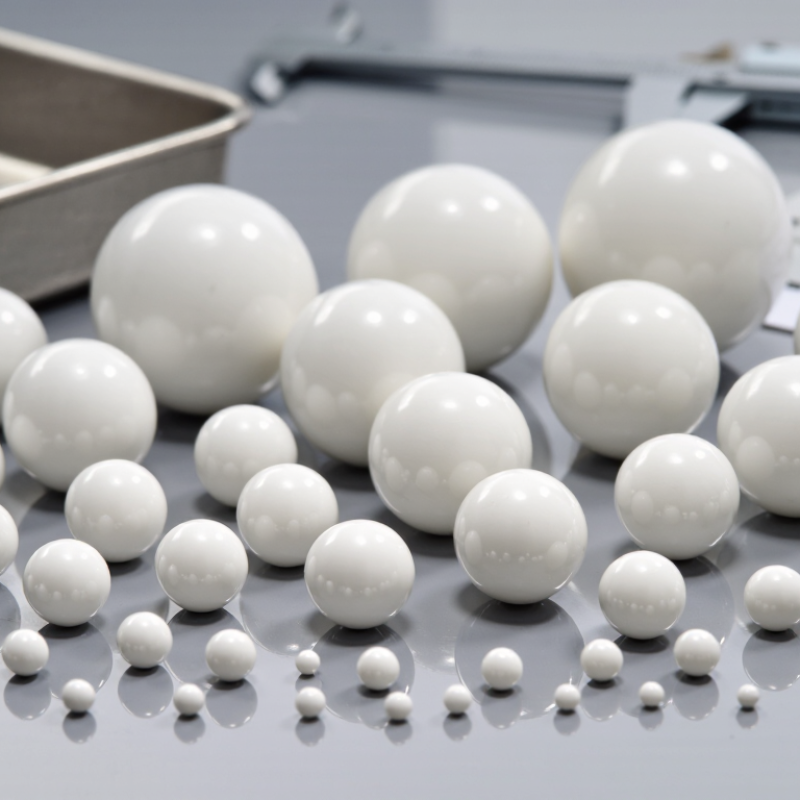
Ask for a material certificate showing yttria content, density, hardness, and phase composition. X-ray diffraction results are more convincing than a generic “zirconia” label. Check ball diameter tolerance under a microscope or calibrated gauge. A 10 mm ball with uneven polishing can create vibration, noise, and early wear. Surface roughness also matters when contamination must stay low. I would test a small batch in the actual slurry or operating fluid before ordering thousands. This step can reveal an uncomfortable mistake: a harder ball may still perform poorly if its toughness, size tolerance, or chemical stability does not match the equipment.

Verify Density and Purity: Quality Balls Typically Reach 5.9–6.1 g/cm³

When buying zirconium ceramic balls, check density before judging appearance. Quality balls typically reach 5.9–6.1 g/cm³. Higher density usually improves grinding force and reduces wear. However, density readings can shift with moisture, temperature, and test methods. Request the testing method, not only the number.

Tip 1: Ask for a recent certificate of analysis. Tip 2: Confirm the density unit is g/cm³. Tip 3: Compare several samples, not one polished ball. A practical check uses the Archimedes method, weighing the ball in air and liquid. Clean, dry surfaces matter. Small air bubbles can distort results.

Tip 4: Verify zirconium oxide purity and stabilizer content. Tip 5: Check whether the quoted purity is measured by mass or composition. Tip 6: Inspect for pores, cracks, and uneven surfaces under strong light. Tip 7: Test a small batch in your actual mill. It may reveal differences that certificates miss. I have seen attractive media perform poorly because internal porosity was overlooked. That mistake is easy to repeat. Ask for lot numbers, dimensional tolerances, and wear data before placing a larger order.

7 Tips for Buying Zirconium Ceramic Balls – Verify Density and Purity: Quality Balls Typically Reach 5.9–6.1 g/cm³

Tip Quality Dimension Typical Reference Data Recommended Verification Why It Matters
1 Bulk Density Dense zirconia ceramic balls commonly measure approximately 5.9–6.1 g/cm³, depending on stabilizer type and composition. Request a lot-specific density report using a recognized method such as Archimedes’ principle; compare the result with the declared grade. Higher and consistent density generally supports better grinding efficiency, impact resistance, and reduced wear.
2 Zirconia Purity and Stabilizer Common grades include yttria-stabilized zirconia and ceria-stabilized zirconia. A typical 3Y-TZP composition contains about 94–95 wt% ZrO₂ with approximately 5–6 wt% Y₂O₃, plus controlled minor oxides. Ask for a chemical composition report or X-ray fluorescence analysis showing ZrO₂, stabilizer, and impurity levels. The stabilizer affects crystal structure, toughness, density, chemical resistance, and resistance to phase transformation.
3 Ball Size and Tolerance Commercial diameters may range from sub-millimeter sizes to several millimeters. The allowable diameter deviation should be stated in micrometers or millimeters. Confirm nominal diameter, diameter tolerance, batch variation, and inspection sampling requirements before purchase. Uniform ball size improves milling consistency, packing behavior, flow, and equipment performance.
4 Sphericity and Surface Finish Precision ceramic balls should have a smooth, uniform surface without visible cracks, chips, pits, or abnormal seams. Sphericity and surface roughness should be specified numerically. Request sphericity, roundness, and surface-roughness data, and inspect a representative sample under magnification. Good geometry reduces friction, contamination, local stress concentration, and uneven wear.
5 Hardness and Wear Resistance Yttria-stabilized zirconia commonly exhibits a Vickers hardness of roughly 1,200 HV, although the actual value depends on composition, porosity, and test conditions. Request the hardness scale, applied load, test standard, and laboratory result; also ask for application-specific wear data. Hardness alone does not predict service life; wear testing under the intended slurry, speed, and load is more meaningful.
6 Porosity and Water Absorption Fully densified zirconia is generally considered non-porous for normal industrial use, with water absorption commonly specified as less than 0.1%. Check open-porosity or water-absorption results and look for internal pores, pinholes, and cracks in sample sections when applicable. Low porosity limits liquid penetration, contamination retention, chipping, and premature fracture.
7 Chemical and Thermal Compatibility Zirconia offers strong resistance to many acids, alkalis, and solvents, but compatibility depends on concentration, temperature, exposure time, and the specific stabilizer. Provide the operating medium and temperature to the supplier, then request a compatibility statement or test data for the exact grade. Selecting the correct grade helps prevent surface degradation, contamination, thermal damage, and unexpected dimensional change.

Note: Reference values are typical ranges rather than universal specifications. Always evaluate a lot-specific certificate and test results against the requirements of the intended application.

Check Performance: Target Hardness Above 1,200 HV and Low Wear

7 Tips for Buying Zirconium Ceramic Balls

Check Performance: Target Hardness Above 1,200 HV and Low Wear

Hardness should be your first performance checkpoint. For demanding milling, target zirconium ceramic balls above 1,200 HV. HV refers to Vickers hardness, measured under controlled laboratory pressure. A higher value usually improves resistance against dents, scratches, and particle impact. However, hardness alone can mislead. Toughness, density, and surface quality also affect service life.

Ask the supplier for recent test data, not only a product brochure. Check the testing method, load, sample location, and measurement variation. In practical use, I would inspect balls under magnification before filling the mill. Tiny chips can create contamination and accelerate wear. Smooth, well-rounded surfaces matter. They reduce friction against the chamber and neighboring media.

Wear testing should match your process conditions. Review results under similar speed, load, slurry concentration, and grinding time. A ball that performs well in dry testing may wear differently in a wet suspension. Measure weight loss before and after a controlled trial. Track color change, particle contamination, and final particle size too. These details reveal real performance. Sometimes the cheapest option appears efficient, but replacement costs tell another story. I have seen specifications look excellent while field results remained average. Treat every claim as a starting point, then verify it with a small batch test.

Match Size, Tolerance, Certification, Packaging, and Total Cost per Kilogram

7 Tips for Buying Zirconium Ceramic Balls

Tip: Match the diameter to your process, not only the equipment drawing. A 1 mm ball may suit fine milling, while larger balls transfer impact energy more effectively. Ask for diameter distribution, roundness, and batch consistency. ISO 3290-2 can support specification work for bearing applications, but process-media buyers need additional requirements. A practical check includes sieve testing and sample inspection.

Tip: Treat tolerance as a performance variable. Tight tolerance can improve packing, flow, and wear control, yet it usually raises the purchase price. Grand View Research’s 2024 zirconium oxide market assessment valued the global market at about USD 1.8 billion in 2023. It also forecast strong growth through 2030, partly from advanced ceramics demand. Report definitions differ, so use market figures carefully. They are useful context, not a purchasing guarantee.

Certification should identify chemical composition, density, hardness, lot number, and test methods. Request a certificate of conformity and traceability documents. Confirm whether the stated density is theoretical or measured. Packaging deserves equal attention. Sealed bags, rigid cartons, and visible lot labels reduce contamination and mixed sizes. Compare total cost per kilogram, including freight, handling, screening, replacement rate, and disposal. A cheaper quote may hide higher wear. I have seen calculations miss freight and reject losses. That mistake is easy to repeat. Recheck the model with one real production batch before committing.