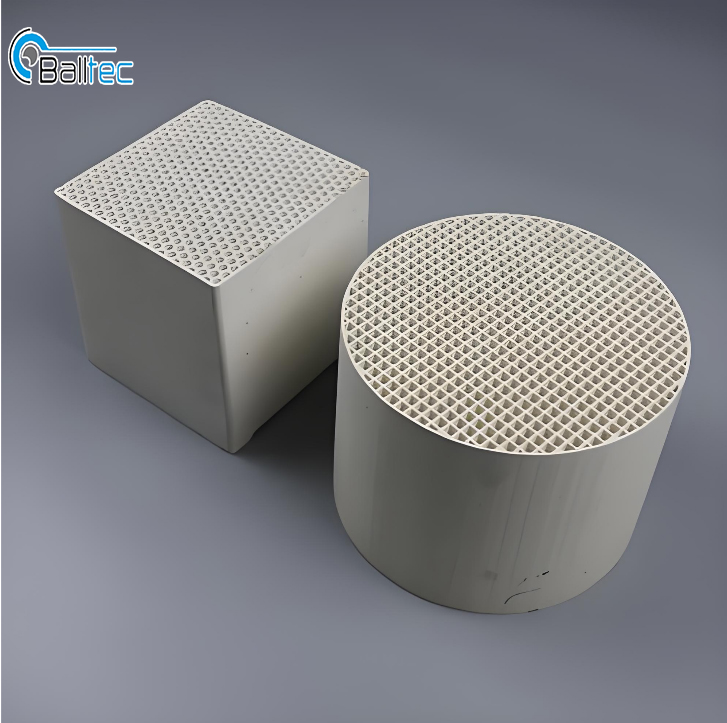
What is honeycomb ceramic packing?
Honeycomb ceramic packing is a porous industrial ceramic with an internal structure consisting of numerous parallel channels in a honeycomb shape. These honeycomb units are separated by thin, grid-like partitions. Compared to conventional bulk ceramics, honeycomb ceramic packing offers advantages such as a large specific surface area, low pressure drop, minimal resistance, high-temperature resistance, excellent chemical stability, low thermal expansion, good thermal insulation, lightweight properties, and high strength. As a result, it is particularly suitable for use as a catalyst carrier in various applications.
Additionally, since fluids can pass through the holes on the partitions that penetrate the upper and lower surfaces of the honeycomb ceramic, the partitions can be utilized for heat exchange and chemical reactions. Currently, honeycomb ceramics are widely used in regenerators for kilns, automotive exhaust purifiers, ozone suppression catalyst carriers, heat exchangers and molten metal filtration in the metallurgical industry, chemical reaction carriers and catalysts in the chemical industry, purification of toxic gases and liquids in the mining industry, spraying in the light industry, and as sound-absorbing materials and kiln insulation materials in the construction industry.
Honeycomb ceramics can be made from a variety of materials. The primary materials include cordierite, mullite, aluminum titanate, silicon carbide, zirconia, silicon nitride, and composite matrices such as cordierite-mullite and cordierite-aluminum titanate.