
Is Zirconia Bead Suitable for Grinding Alumina Powder?
Introduction
Alumina powder (Al₂O₃) is a critical industrial material renowned for its high hardness (Mohs hardness 9.0), superior thermal stability, and chemical inertness. It finds widespread use in advanced ceramics, electronic components, and abrasive manufacturing—all fields that demand ultra-fine, uniformly sized powder. Grinding, as the core step in refining alumina powder, heavily depends on the choice of grinding media. Zirconia beads, particularly yttria-stabilized zirconia (YSZ) beads, are often a top candidate for this task. This article examines the suitability of zirconia beads for grinding alumina powder by analyzing their compatibility, unique advantages, practical application considerations, and comparisons with alternative media.
1. Compatibility: The Foundation of Zirconia Beads for Alumina Grinding
The suitability of zirconia beads for alumina powder grinding lies in the inherent match between their physical-chemical properties and the characteristics of alumina:
- Hardness Balance: Zirconia beads boast a Mohs hardness of 8.5–9.0, which is nearly identical to that of alumina powder (Mohs 9.0). This balance ensures two key outcomes: the beads can effectively break down hard alumina agglomerates without struggling with insufficient abrasive force, and they are not excessively worn down by the tough alumina particles—avoiding both inefficient grinding and excessive contamination from bead debris.
- Ultra-Low Wear Rate: High-purity YSZ beads exhibit an extremely low wear rate (0.1–0.3 ppm/h) during grinding operations. For alumina powder, which often requires strict purity standards (e.g., 99.5% Al₂O₃ for electronic ceramics), this minimal wear is critical: it prevents zirconia impurities from seeping into the powder and compromising its performance. Unlike cheaper alternatives, zirconia beads do not introduce unwanted components that alter the powder’s chemical composition or functional properties.
- Mechanical Durability: Alumina grinding typically involves high-speed agitation (e.g., in sand mills) and repeated impact forces. Zirconia beads excel here with their high compressive strength (≥2000 MPa) and resistance to thermal shock (stable at temperatures up to 1200°C). These properties allow them to withstand the intense mechanical stress and temperature rises during grinding, minimizing bead fragmentation and avoiding powder contamination from broken media particles.
2. Key Advantages of Zirconia Beads Over Other Media
Compared to common alternative grinding media (such as alumina beads and silicon carbide beads), zirconia beads offer distinct benefits tailored to alumina powder processing:
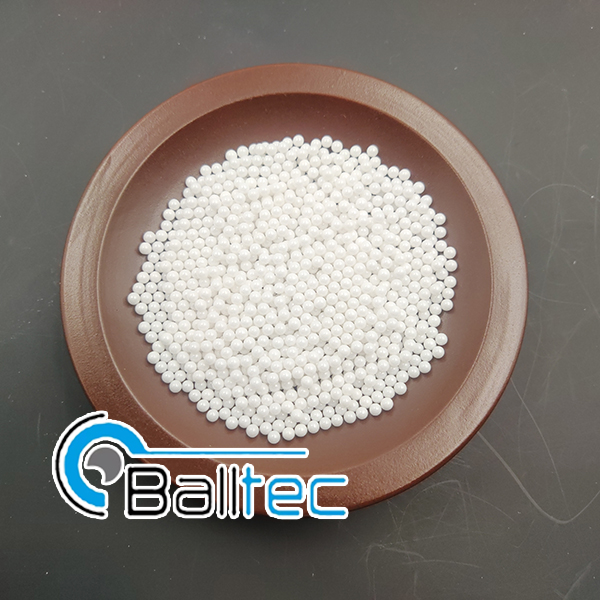
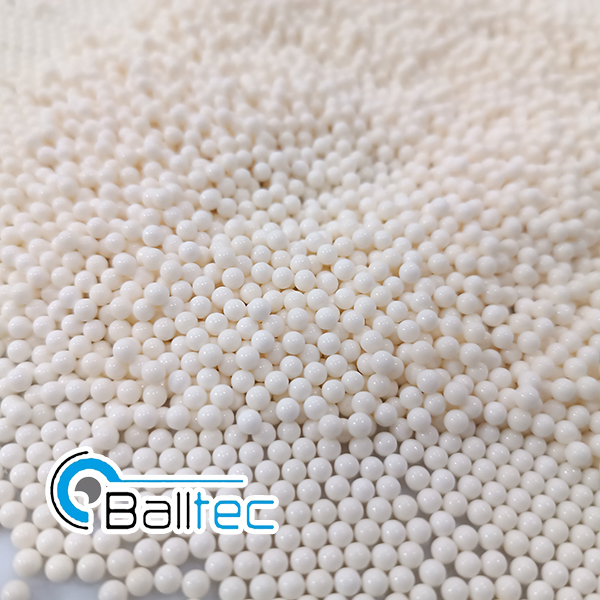
- Efficient Fine Grinding: Zirconia beads have a high density (6.0–6.2 g/cm³), which generates stronger centrifugal force and impact energy in grinding equipment. This is particularly valuable for alumina powder, which often requires ultra-fine particle sizes (e.g., D50 <1 μm for advanced ceramic substrates). The high impact energy accelerates the breakdown of rigid alumina agglomerates, reducing grinding time by 20–30% compared to lower-density media like alumina beads (density ~3.8 g/cm³).
- Uniform Particle Size Distribution: Zirconia beads are manufactured with strict control over spherical shape and size uniformity. This ensures consistent contact between the beads and alumina particles during grinding, avoiding issues like over-grinding of some particles and under-grinding of others. The result is a narrow particle size distribution (e.g., span <1.5)—a critical requirement for alumina-based products, as uniform particle sizes ensure stable sintering performance and reliable product quality.
- Chemical Inertness: Alumina powder is often ground in aqueous or solvent-based slurries. Zirconia beads are chemically inert to most acids (except hydrofluoric acid) and organic solvents, meaning they do not react with the grinding medium or leach ions into the slurry. This preserves the chemical purity of the alumina powder, which is essential for applications like high-performance ceramics, where even trace impurities can lead to structural defects or reduced functionality.
3. Practical Considerations for Effective Application
While zirconia beads are well-suited for alumina grinding, proper use requires attention to specific factors to maximize efficiency and avoid issues:
- Bead Size Selection: The size of zirconia beads should align with the initial and target particle sizes of the alumina powder. For coarse pre-grinding (initial particle size 50–100 μm), 2–3 mm beads are ideal, as their larger size maximizes impact force for breaking down large agglomerates. For ultra-fine grinding (target particle size <1 μm), switch to smaller beads (0.3–0.5 mm)—their smaller size increases the number of contact points with fine particles, enhancing shear force and refining the powder to the desired fineness.
- Loading Ratio Control: In sand mills (the most common equipment for alumina grinding), the zirconia bead loading ratio should be maintained at 70–80% of the effective grinding chamber volume. A ratio exceeding 85% increases friction between beads, leading to excessive temperature rises and accelerated wear; a ratio below 65% reduces impact frequency, slowing down grinding and lowering efficiency.
- Contamination Monitoring: Even with low wear, it is important to regularly test the alumina powder for zirconia content (e.g., via X-ray fluorescence spectroscopy) to ensure it stays below the application’s purity threshold (e.g., <0.1% ZrO₂ for high-purity alumina). Beads should be replaced promptly when their wear rate exceeds 0.3 ppm/h to prevent excessive contamination.
4. Comparison with Alternative Grinding Media
To further confirm the suitability of zirconia beads, it is helpful to compare them with two common alternatives for alumina grinding:
- Alumina Beads: These beads have the advantage of low cost and share the same main component (Al₂O₃) as the powder, which seems to reduce "foreign" contamination. However, their higher wear rate (1.0–1.5 ppm/h) means they shed more Al₂O₃ particles during grinding—these particles are often of inconsistent size and purity, disrupting the uniformity of the target alumina powder and compromising product quality.
- Silicon Carbide Beads: These beads have high hardness and fast grinding speed, making them suitable for extremely tough materials. However, their high wear rate leads to significant silicon carbide (SiC) contamination in the alumina powder. SiC impurities are chemically and physically incompatible with alumina, ruining the powder’s purity and rendering it unsuitable for high-performance applications like electronic ceramics.
In contrast, zirconia beads avoid the critical flaws of these alternatives: they minimize contamination through low wear and do not introduce incompatible impurities, while maintaining high grinding efficiency.
Conclusion
Zirconia beads (especially YSZ beads) are highly suitable for grinding alumina powder. Their hardness balance, ultra-low wear rate, mechanical durability, and chemical inertness directly address the core challenges of alumina processing—ensuring efficient, high-purity, and uniform grinding. While zirconia beads have a higher upfront cost than alternatives, the benefits of reduced contamination, faster processing times, and consistent powder quality make them a cost-effective choice for industrial applications requiring high-performance alumina powder. By adhering to proper bead size selection, loading ratio control, and wear monitoring, operators can fully leverage the advantages of zirconia beads to optimize alumina grinding processes.