
5. Influence on Applications
The chemical properties of zirconia beads directly determine their suitability for specific applications:
• Bead Milling: High chemical stability and low reactivity ensure that YSZ beads do not contaminate the milled materials, making them ideal for producing high-purity powders in the electronics, ceramics, and pharmaceutical industries.
• Polishing and Finishing: The inert surface of zirconia beads prevents chemical reactions with polished surfaces, enabling precise and damage-free material removal.
• Catalysis Support: The unique surface chemistry of zirconia can be tailored to support catalyst materials, facilitating chemical reactions without interfering with the catalyst's activity.
In conclusion, the chemical properties of zirconia beads—including their composition, stability, reactivity, and surface characteristics—are critical factors that govern their performance across diverse industrial applications. Understanding these properties allows for the rational selection and optimization of zirconia beads, ensuring maximum efficiency and quality in manufacturing processes.
Chemical Properties of Zirconia Beads: A Comprehensive Overview
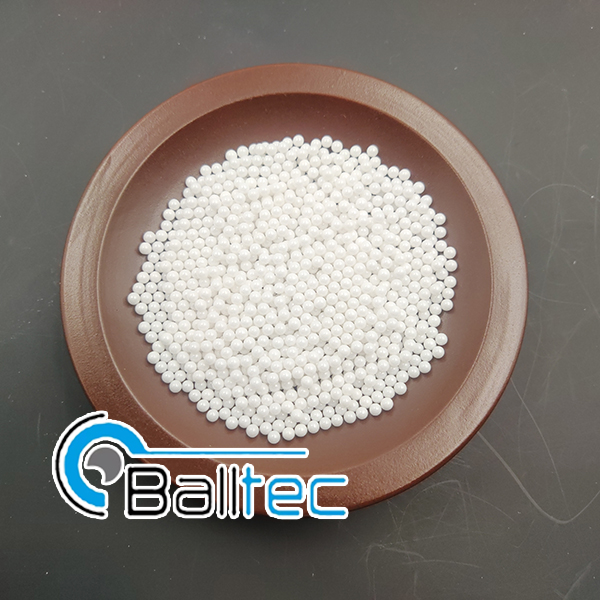
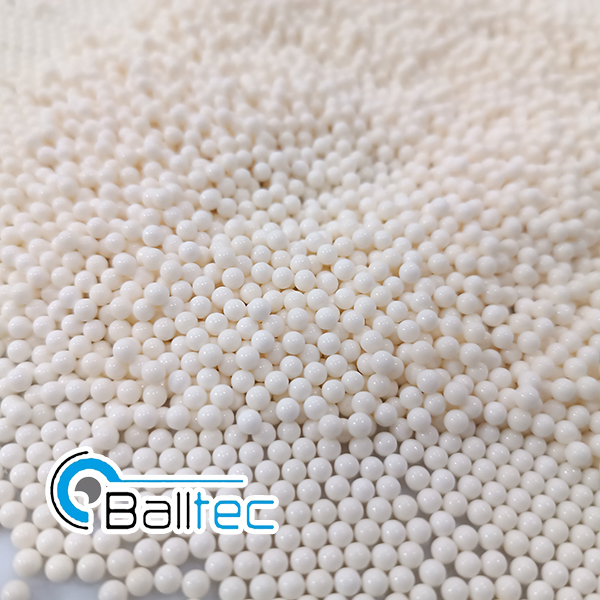
Zirconia beads, primarily composed of zirconium dioxide (ZrO₂), are widely used in various industrial applications due to their unique chemical properties. This article delves into the fundamental chemical characteristics of zirconia beads, exploring their reactivity, stability, and interaction with different substances.
1. Chemical Composition and Phase Structure
The chemical composition of zirconia beads significantly influences their properties. Yttria-stabilized zirconia (YSZ) beads, the most common type, typically contain 94-95% ZrO₂ and 5-6% yttrium oxide (Y₂O₃) as a stabilizer. The addition of Y₂O₃ transforms the metastable monoclinic phase of ZrO₂ into a more stable tetragonal phase at room temperature. This phase transformation enhances the mechanical strength and fracture toughness of the beads, making them suitable for high-intensity applications such as bead milling and polishing.
In contrast, zircon silicate (ZrSiO₄) beads, also known as 65 zirconia beads due to their approximate 65% ZrO₂ content, have a different chemical structure. The presence of silica (SiO₂) forms a compound with zirconia, resulting in a lower density and hardness compared to YSZ beads. This composition gives zircon silicate beads distinct chemical behaviors, particularly in terms of corrosion resistance and reactivity with acidic or alkaline media.
2. Chemical Stability
2.1 Acid and Alkali Resistance
Zirconia beads exhibit excellent chemical stability in both acidic and alkaline environments. YSZ beads, with their high ZrO₂ purity, show minimal reactivity with most common acids (e.g., hydrochloric, sulfuric, and nitric acids) at room temperature. They can withstand exposure to concentrated acids for extended periods without significant degradation, making them ideal for applications involving corrosive substances. However, at elevated temperatures (above 300°C), strong acids may gradually dissolve the yttria stabilizer, leading to phase transformation and structural weakening.
Similarly, zirconia beads demonstrate good resistance to alkalis. They can endure contact with sodium hydroxide (NaOH) and potassium hydroxide (KOH) solutions without substantial chemical reactions, provided the temperature remains below 200°C. This alkali resistance is crucial for applications in the pharmaceutical and chemical industries, where beads may encounter alkaline media during the grinding or dispersion processes.
2.2 Thermal Stability
Thermally, YSZ beads maintain their chemical integrity up to approximately 1200°C under normal conditions. The yttria-stabilized tetragonal phase resists transformation into the less stable monoclinic phase until reaching a high-temperature threshold (around 1200-1400°C), at which point the beads may experience phase-induced volume changes. This thermal stability allows YSZ beads to be used in high-temperature applications such as ceramic sintering and metal casting processes.
In comparison, zircon silicate beads have a lower thermal stability due to their complex chemical structure. The presence of SiO₂ reduces the overall melting point of the beads, making them more prone to softening and deformation at temperatures above 800°C.
3. Reactivity with Other Substances
3.1 Oxidation and Reduction
Under normal atmospheric conditions, zirconia beads are highly resistant to oxidation. The stable ZrO₂ lattice structure forms a passive oxide layer on the surface, preventing further oxygen penetration. Even at elevated temperatures, the oxidation rate of YSZ beads remains negligible up to 1000°C. However, in reducing atmospheres (e.g., hydrogen or carbon monoxide environments), zirconia may undergo partial reduction, leading to the formation of oxygen vacancies and potential changes in its electrical and optical properties.
3.2 Interaction with Organic Compounds
Zirconia beads generally have low reactivity with organic substances. Their inert surface minimizes chemical interactions with organic solvents, polymers, and biological materials. This property makes them suitable for applications in the food, cosmetics, and biotechnology industries, where contamination-free grinding and dispersion are essential. For example, in the production of pharmaceutical powders, YSZ beads ensure that the final product remains chemically unaltered during the milling process.
4. Surface Chemistry
The surface chemistry of zirconia beads significantly impacts their performance in various applications. The surface of YSZ beads is slightly hydrophilic due to the presence of hydroxyl (-OH) groups, which can form hydrogen bonds with polar substances. This characteristic enhances the bead's ability to disperse in aqueous media, making it effective for wet grinding processes. Additionally, the surface can be modified through chemical treatments (e.g., silanization or coating with polymers) to alter its wettability, adhesion, or reactivity, further expanding its application scope.
In contrast, zircon silicate beads have a more complex surface chemistry influenced by the presence of silica. Their surface may exhibit different adsorption behaviors towards metal ions and organic molecules, which can be exploited in applications such as water purification and ion exchange processes.