Pingxiang Baitian New Materials Co., Ltd

Leave Your Message
Choosing reliable Zirconia Silicate Beads manufacturers requires more than comparing prices or polished product photographs. These beads support grinding and dispersion in paints, ceramics, minerals, inks, and other demanding industries. Their performance depends on zirconium content, density, roundness, wear resistance, bead size, and production consistency. A small variation can influence energy consumption, contamination levels, and final particle fineness.
This guide examines ten notable manufacturers through practical and verifiable criteria. These include manufacturing experience, technical support, quality-control procedures, laboratory testing, export capability, and customer feedback. Factory equipment also matters. A controlled sintering line, clean polishing process, and accurate screening system can produce smoother beads with fewer fractured particles. Certifications are useful evidence, but they should not replace independent testing or application trials.
Real results vary.
A bead that performs well in ceramic milling may not suit high-viscosity coatings. Therefore, buyers should review density data, chemical composition, size tolerance, packaging details, and recommended operating conditions. Direct communication with the manufacturer can reveal useful details, such as batch traceability and replacement policies. However, public information is sometimes incomplete, and rankings can never capture every factory’s daily performance. This article offers a careful starting point rather than an absolute verdict. Readers should confirm technical claims through samples, inspection reports, and controlled production tests before making a purchasing decision.
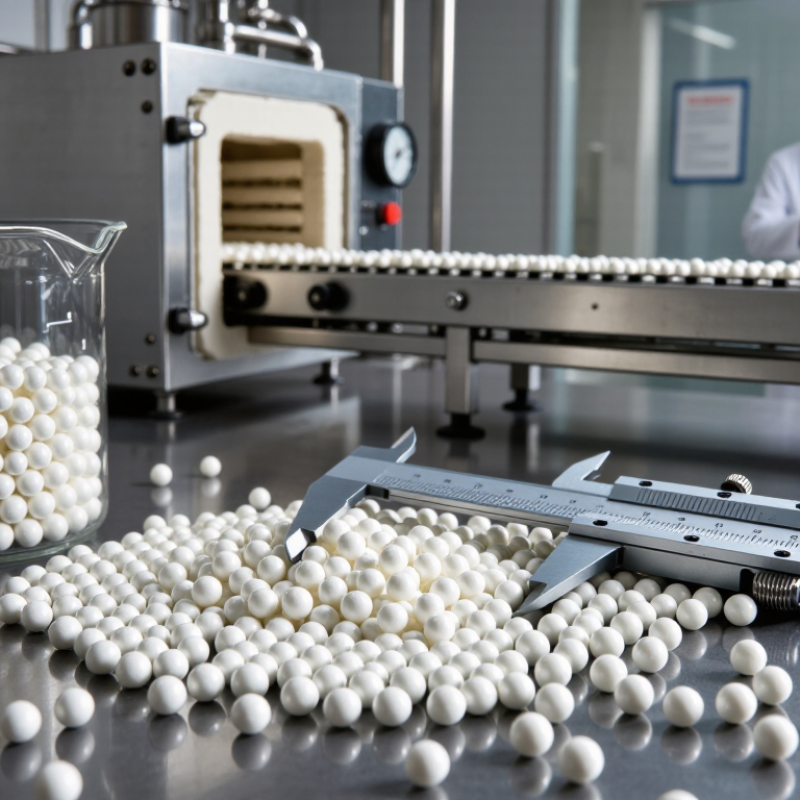
Zirconia silicate beads are ceramic grinding media used in paint, ink, minerals, coatings, and advanced material processing. They are generally produced from zirconium silicate-based powders, sometimes with stabilizing ceramic additives. Their balanced density offers effective impact and shear without the extreme cost of fully stabilized zirconia beads. The result is a practical option for many horizontal and vertical mills.
Production begins with carefully measured raw powders. Manufacturers mix them with water and temporary binders to create a uniform slurry. The slurry is granulated or shaped into rounded green beads. After controlled drying, the beads are sintered at high temperatures. This step develops hardness and internal strength. Finished beads may be polished, screened, and separated by diameter. Typical quality checks include density, crushing strength, roundness, wear rate, and size distribution.
Small differences matter. Uneven drying can create hidden cracks. Poor screening may increase mill vibration and contamination. Experienced producers therefore inspect samples from each batch, not only the final package. Practical testing should match the bead to the mill speed, product viscosity, and target particle size. A bead that performs well in one formulation may wear faster in another. The name “zirconia silicate” can also cause confusion, because compositions and manufacturing routes vary between suppliers. Buyers should request a technical data sheet, test method, and batch traceability. No batch is flawless, so transparent testing remains more valuable than exaggerated performance claims.
| No. | Bead Size Range | Typical ZrSiO4 Content | Typical Bulk Density | Manufacturing Route | Recommended Milling Use | Key Performance Characteristics | Common Quality-Control Checks |
|---|---|---|---|---|---|---|---|
| 1 | 0.1–0.3 mm | Approximately 60–70% | About 4.0–4.2 g/cm³ | Fine zircon sand preparation, proportioning, fusion or calcination, crushing, shaping, sizing, polishing and cleaning | Fine dispersion of coatings, inks, pigments and electronic slurries | High surface area and good fine-particle dispersion; requires efficient separator systems | Particle-size distribution, roundness, contamination level and bulk density |
| 2 | 0.3–0.5 mm | Approximately 60–70% | About 4.0–4.2 g/cm³ | Fused or sintered zirconium-silicate granules are rounded, classified and surface-cleaned | Water-based coatings, agricultural formulations and low-viscosity dispersions | Good balance between grinding efficiency, flowability and separator recovery | Size classification, crush resistance, moisture, whiteness and wear rate |
| 3 | 0.5–0.8 mm | Approximately 60–70% | About 4.0–4.2 g/cm³ | Raw materials are mixed, thermally treated, formed into beads and screened into narrow size fractions | Paints, printing inks, mineral dispersions and general-purpose laboratory milling | Stable operation with moderate energy demand and comparatively easy bead separation | Roundness, density uniformity, size distribution and surface defects |
| 4 | 0.8–1.0 mm | Approximately 60–70% | About 4.0–4.2 g/cm³ | Controlled heating and densification followed by mechanical rounding and precision screening | Industrial coatings, ceramic suspensions and medium-viscosity products | Good impact resistance and suitable for continuous bead mills | Bulk density, abrasion loss, dimensional tolerance and magnetic contamination |
| 5 | 1.0–1.5 mm | Approximately 60–70% | About 4.0–4.2 g/cm³ | Thermal synthesis or fusion, coarse crushing, bead forming, grading and final dedusting | General pigment grinding, ceramic raw materials and high-throughput dispersions | Higher throughput and reduced risk of screen blockage in many standard mills | Crushing strength, wear resistance, density and grading accuracy |
| 6 | 1.5–2.0 mm | Approximately 60–70% | About 4.0–4.2 g/cm³ | Selected zirconium-silicate feedstock is densified, rounded, screened and washed | High-viscosity coatings, ceramic slips and coarse mineral processing | Reliable circulation and lower sensitivity to coarse feed particles | Particle integrity, abrasion, moisture, surface cleanliness and size consistency |
| 7 | 2.0–2.5 mm | Approximately 60–70% | About 4.0–4.2 g/cm³ | Large granules are thermally consolidated, rounded, screened and polished to remove sharp edges | Coarse grinding, ceramic processing and applications requiring strong media circulation | Good mechanical durability and lower initial cost per unit volume | Shape factor, edge defects, crush strength and chemical cleanliness |
| 8 | 2.5–3.0 mm | Approximately 60–70% | About 4.0–4.2 g/cm³ | Coarse zirconium-silicate particles are formed, heat-treated, rounded and separated by screening | Heavy-duty milling, coarse ceramic powders and selected mineral slurries | High flowability and good resistance to large-particle impact | Diameter tolerance, abrasion loss, fracture rate and bulk density |
| 9 | Mixed size grades | Approximately 60–70% | About 4.0–4.2 g/cm³ | Multiple screened fractions are blended under controlled proportions after cleaning and inspection | Cost-sensitive general milling where a broad working-size distribution is acceptable | Flexible loading and broad process compatibility, but less uniform grinding action | Blend ratio, fines content, size distribution and batch-to-batch consistency |
| 10 | Custom specification | Usually specified by purchase agreement | Usually about 4.0–4.2 g/cm³ | Feedstock selection, formulation, thermal treatment, bead forming, grading and inspection are adjusted to the application | Specialized coating, ink, ceramic, mineral or chemical-processing requirements | Can be optimized for size tolerance, wear behavior, whiteness or application-specific chemistry | Certificate of analysis, chemical composition, density, size distribution, abrasion and visual inspection |